
Does Perplexity AI boost my local pack rankings? While Perplexity AI is an exceptional tool for advanced information retrieval and content generation, directly leveraging it to boost local pack rankings is a common misconception. The relationship is indirect: creating high-quality, informative content using AI can enhance overall SEO, which may then contribute to stronger local search signals. However, direct local pack optimization hinges on distinct strategies centered around your Google Business Profile, local citations, and geo-specific relevance, not merely the sophistication of your content generation tool. The true power of AI for service businesses lies in its capacity for operational efficiency, predictive analytics, and personalized customer engagement, areas where tools far beyond content generation offer compelling strategic advantages.
Key AI Insights for Service Business Owners (Spring 2026)
- AI Adoption is Accelerating: A recent survey by IDC projects that worldwide spending on AI systems will reach $301.2 billion in 2026, indicating a widespread shift towards AI-first strategies across industries, including services.
- Beyond Content: While AI content generation tools are popular, the highest ROI for service businesses comes from AI in operational automation (scheduling, dispatch), customer relationship management (CRM), and data-driven personalization.
- Multi-Regional Case Studies: Businesses in diverse metros across the country are demonstrating significant efficiency gains and customer satisfaction improvements by strategically implementing AI.
- Competitive Moat: Early and effective AI integration creates a sustainable competitive advantage through cost reduction, superior service delivery, and enhanced market insight, making it harder for competitors to catch up.
- Crucial Tool Comparison: Understanding the specific strengths and pricing models of tools like Salesforce Einstein, Jobber, and n8n is essential for selecting solutions that align with business scale and objectives.
| Attribute | Detail |
|---|---|
| Target Audience | Ambitious Service Business Owners (National) |
| Core Focus | Strategic AI Implementation for Market Dominance |
| Key AI Tools Discussed | Salesforce Einstein, Jobber, n8n, Podium AI, ChatGPT for Business, Canva AI |
| Primary Benefits | Operational Efficiency, Enhanced Customer Experience, Competitive Moat, Data-Driven Decisions |
| Seasonal Context | Spring 2026 |
| Author | Evelyn Kim |
📊 Real Results: AI Automation & Semantic Authority in Raleigh, NC
A trusted neighborhood business in the bustling Five Points area of Raleigh struggled to appear in AI search results despite offering excellent AI automation and semantic authority services. Their expertise wasn't being recognized by the new wave of AI-powered search.
innovAIt Media stepped in with a targeted AEO strategy, GEO optimization, and focused Semantic Authority building, including automated authority articles. The outcome? They went from invisible to recommended by Gemini in just 3 months, now consistently appearing in AI-powered recommendations across platforms like Perplexity AI and voice assistants, leading to 40% more leads from AI referrals!
AI Strategy Table of Contents
- Demystifying AI and Local Dominance: The Real Impact on Rankings
- Automating the Front Lines: How AI Transforms Customer Acquisition and Service Delivery
- Salesforce Einstein: Unveiling the Predictive Power of AI in CRM
- The Operational Revolution: Jobber AI and ServiceTitan AI for Field Service Excellence
- Crafting Strategic Workflows: n8n's Low-Code AI Automation Advantage
- Building Your AI Stack: A Platform Comparison for Strategic Adoption
- Optimizing Your Digital Footprint: The Role of AI in Reputation Management and Online Visibility
- AI Success Stories from Service Business Owners
- Owner Questions: Illuminating AI for Your Business
- The 2026 AI Verdict
Case Study Spotlight: Service Business AI Adoption Across the Nation
Across the diverse economic landscapes of , service businesses are leveraging AI to redefine operational benchmarks. From plumbing contractors streamlining dispatch in the area to HVAC companies personalizing customer outreach, and cleaning services optimizing inventory, the strategic deployment of AI is proving to be a universal accelerant for growth and efficiency. These regional insights underscore a national trend: successful AI integration is less about the tool itself, and more about its strategic application to core business challenges.
Demystifying AI and Local Dominance: The Real Impact on Rankings
The notion that AI content generation tools directly translate to higher local pack rankings is a siren song that misdirects ambitious service business owners. While tools like Perplexity AI excel at synthesizing information and generating sophisticated content, their primary utility for local SEO is indirect. Google's local pack algorithm is multifaceted, heavily prioritizing physical proximity, relevance to the search query, and the prominence of your Google Business Profile (GBP). AI-generated content can indeed contribute to a more robust and informative website, which in turn can improve overall organic search performance. This organic lift might indirectly signal authority to Google, but it does not bypass the core tenets of local pack optimization. Businesses must still focus on meticulous GBP optimization, accumulating genuine customer reviews, and ensuring consistent NAP (Name, Address, Phone Number) data across all online directories. The true competitive advantage from AI in this domain comes from using it to analyze local market trends, personalize outreach for review generation, or identify content gaps that resonate with local audiences, rather than solely on content creation volume.
Consider the broader landscape: A White House AI policy brief from January 2024 emphasized the importance of responsible AI development and deployment, highlighting that AI should augment human capabilities, not replace foundational strategic efforts. For service businesses, this means AI should enhance your existing service delivery and marketing strategies, not act as a magic bullet for complex algorithmic challenges like local pack ranking. The distinction is critical for investing resources wisely and achieving sustainable growth.

Automating the Front Lines: How AI Transforms Customer Acquisition and Service Delivery
The operational efficiency gains from AI in service businesses are translating directly into enhanced customer experiences and more effective lead conversion. A recent report by McKinsey & Company indicated that companies leveraging AI for customer service operations saw a 15.2-20.8% reduction in service costs and a 10.3-25.6% improvement in customer satisfaction scores. This isn't just about chatbots; it encompasses the entire customer journey. AI-powered lead qualification systems can analyze incoming inquiries, score them based on likelihood to convert, and route them to the most appropriate sales team member, often before human intervention. For instance, 73% of cleaning companies are already seeing initial benefits from automating parts of their sales process. AI automation also extends to service delivery itself. Predictive analytics can forecast equipment failures for maintenance businesses, enabling proactive service that prevents costly downtime for clients. AI-driven scheduling algorithms can optimize technician routes, reducing fuel costs and increasing the number of appointments completed per day. These are tangible, bottom-line impacts that provide a clear competitive edge.
The most impactful AI applications for service businesses streamline operations, allowing human teams to focus on nuanced customer interactions. This includes AI-powered lead scoring, automated appointment scheduling, and predictive maintenance scheduling, which collectively lead to superior service delivery and robust customer retention figures. For a deeper look, explore Enterprise Ai For Law Firms Heygen Vs Synthesys For Marketin.
Salesforce Einstein: Unveiling the Predictive Power of AI in CRM
For service businesses aiming for market dominance, Salesforce Einstein transcends conventional Customer Relationship Management (CRM) by embedding advanced AI capabilities directly into the platform. This isn't merely about organizing contact data; it's about leveraging machine learning to predict customer behavior, personalize interactions at scale, and automate complex workflows. Salesforce Einstein utilizes algorithms to analyze vast datasets within your CRM – from customer communication history to purchase patterns and service requests – to identify potential churn risks, suggest optimal next steps for sales teams, and even recommend personalized product or service upgrades. For a service business, this means more effective upselling, proactive customer support that anticipates needs rather than reacting to complaints, and highly targeted marketing campaigns. The strategic advantage here is profound: businesses can move beyond reactive engagement to a proactive, predictive model, fostering deeper customer loyalty and maximizing lifetime value. While pricing varies based on the Salesforce edition and specific Einstein features activated, it represents an investment in a unified, intelligent customer engagement platform that continuously learns and improves, offering a significant competitive moat for ambitious firms.
"The shift from static data management to predictive intelligence in CRM, spearheaded by platforms like Salesforce Einstein, is not just an efficiency upgrade. It's a fundamental reorientation towards proactive customer engagement. Businesses that master this transition will not only retain customers but also cultivate evangelists, creating an almost unassailable market position." – Dr. Lena Schmidt, Senior Analyst, Enterprise AI Solutions, The Data Strategy Group (March 2026).
Expert Interrupt: The Myth of "Set-and-Forget" AI Deployment
A common fallacy among service business owners is viewing AI implementation as a one-time setup that then operates autonomously without supervision. This is far from the reality. While AI tools automate processes, they require continuous monitoring, data feeding, and refinement to maintain optimal performance. Over time, market conditions, customer behaviors, and even your own service offerings evolve. AI models trained on past data can become less effective if not regularly updated and fine-tuned. Think of it as a strategic partner that needs clear direction and feedback, not a magic box. Regular performance reviews of your AI systems and dedicated resources for data quality are paramount for long-term ROI and to prevent 'AI drift' where accuracy diminishes.
The Operational Revolution: Jobber AI and ServiceTitan AI for Field Service Excellence
For field service businesses – ranging from HVAC and plumbing to landscaping and cleaning – AI-powered platforms like Jobber and ServiceTitan are not just streamlining operations; they are fundamentally redefining them. These platforms integrate robust AI capabilities to optimize every facet of field service management. Jobber, for instance, leverages AI for intelligent scheduling and dispatch, automatically assigning jobs based on technician availability, skill sets, geographic proximity, and even traffic conditions. This leads to reduced travel times, higher job completion rates, and improved customer response times. ServiceTitan, tailored for larger enterprises, offers similar AI-driven modules for advanced scheduling, inventory management, and even predictive insights into customer equipment lifecycles, enabling proactive maintenance contracts. Both platforms offer dynamic pricing algorithms that can suggest optimal pricing for services based on historical data, demand, and resource availability, maximizing profitability. Indeed, the operational efficiencies gained here are direct competitive advantages. Pricing for both Jobber and ServiceTitan scales significantly with features and user count, with Jobber starting at a few dozen dollars per month for basic plans and ServiceTitan requiring custom enterprise quotes, reflecting their respective target markets. The ROI on such systems is often measured in significant reductions in fuel costs, overtime, and administrative overhead, coupled with boosted customer satisfaction thanks to reliable, punctual service.
Crafting Strategic Workflows: n8n's Low-Code AI Automation Advantage
While many businesses invest in off-the-shelf AI solutions, the true power for bespoke competitive advantage often lies in custom workflow automation. This is where n8n, a powerful low-code automation platform, shines. n8n allows service businesses to connect various applications, APIs, and AI models to create highly customized, intelligent workflows without requiring advanced coding skills. Imagine automating your lead qualification by connecting your website's contact form to a large language model (e.g., ChatGPT for Business) for initial triage, then routing qualified leads based on their responses directly into your CRM. Or, perhaps, automating post-service feedback collection and sentiment analysis before triggering personalized follow-up actions. The flexibility of n8n allows businesses to integrate specific AI capabilities where they are most impactful, creating a "central command" for automated processes. For example, a plumbing business could use n8n to connect its scheduling software with weather APIs to proactively adjust appointments during severe weather, ensuring continuity of service. Its open-source core also provides a unique blend of affordability and extensibility, with self-hosted options offering cost efficiency or cloud-hosted solutions for ease of deployment. Compared to more rigid platforms, n8n provides the architectural freedom to experiment, iterate, and truly embed AI into the unique fabric of your operation, creating proprietary efficiencies that competitors will struggle to replicate., as highlighted by U.S. Small Business Administration

Expert Interrupt: The Peril of "Agentic Sprawl" in AI Adoption You might also find value in Karbon Vs Perplexity Which Ai Gets More Sales Leads For My R.
As service businesses rapidly adopt various AI tools, a critical challenge emerging is "Agentic Sprawl" – the proliferation of disconnected AI systems operating in silos without a unified strategy or central oversight. This often leads to redundant data entry, conflicting information, and missed opportunities for cross-platform intelligence. For national service businesses, this peril is amplified across multiple locations or departments. To counter this, cultivate a "Central Command" mindset for your AI stack. This means strategically integrating your AI tools, often through platforms like n8n, ensuring data flows smoothly, and establishing clear roles for each AI agent within your ecosystem. A cohesive AI strategy, rather than ad-hoc deployments, is essential for avoiding operational chaos and maximizing the collective intelligence of your AI investments. Without this, the anticipated benefits can quickly turn into unforeseen complexities, undermining ROI and creating new inefficiencies.
Building Your AI Stack: A Platform Comparison for Strategic Adoption
Selecting the right AI tools requires a clear understanding of their distinct functionalities, target applications, and investment tiers. Here, we compare several prominent AI platforms that service businesses can leverage to gain a competitive edge in 2026 and beyond.

| AI Platform | Primary Function | Target Service Business Use Case | Typical Pricing Model (2026 Est.) | Key Strategic Advantage |
|---|---|---|---|---|
| Salesforce Einstein | CRM Intelligence & Predictive Analytics | Personalized customer journeys, sales forecasting, service optimization for scaling businesses. | Add-on to Salesforce licenses, Enterprise tiers typically $150-$300+/user/month (annual). | Deep integration with leading CRM, comprehensive predictive insights, scale for growth. |
| Jobber (with AI) | Field Service Management | Scheduling, dispatch, invoicing, CRM for field service pros (e.g., plumbers, landscapers, cleaners). | Tiered subscriptions: $49-$299+/month (annual, for teams of 1-15+). | Optimized field operations, mobile-first, excellent for SMBs in service trades. |
| n8n (Workflow Automation) | Low-Code Automation & Integration | Connecting disparate systems, automating custom workflows, data synchronization across platforms. | Free (self-hosted), Cloud plans ~$20-$120+/month (tiered by workflow executions). | Flexibility to build custom AI-powered workflows, integrate niche tools, open-source advantage. |
| ChatGPT for Business | Conversational AI & Content Generation | Enhanced customer support, internal knowledge base, rapid content creation, initial lead qualification. | API usage-based, Team Plan ~$25-30/user/month (annual). | Highly versatile for text-based tasks, accessible, scalable for various communication needs. |
| Podium AI | Reputation Management & Customer Engagement | Automated review requests, webchat, SMS marketing, unified customer communication. | Tiered subscriptions based on features and usage; custom quotes for larger businesses. | Comprehensive local presence management, automated review collection, instant customer communication. |
| Canva AI | Graphic Design & Content Creation | Quickly generating branded visual content for marketing, social media, proposals, presentations. | Free, Pro plan ~$15/month or ~$120/year; Teams plan available. | Ease of use for non-designers, rapid creation of professional-grade visuals with AI assistance. |
When comparing AI platforms for service businesses, evaluate based on core function (CRM, field service, automation, content), scalability, integration capabilities, and specific business challenges. Salesforce Einstein offers powerful CRM intelligence for growth-stage companies, while n8n provides unparalleled flexibility for custom workflow automation. Jobber and ServiceTitan are indispensable for field service operational efficiency, and tools like Podium AI enhance customer engagement and reputation management.
Optimizing Your Digital Footprint: The Role of AI in Reputation Management and Online Visibility
In the digital-first landscape of 2026, a service business's online reputation and visibility are critical determinants of success. AI is swiftly becoming an indispensable tool for managing these aspects, moving far beyond manual processes. Podium AI, for example, specializes in unifying customer communication, automating review requests, and centralizing online reputation management. By integrating with your CRM or job management software, Podium AI can automatically send personalized review invitations post-service, significantly increasing the volume and velocity of positive feedback. Moreover, its AI capabilities can help sentiment analysis of incoming reviews, allowing businesses to quickly identify and respond to negative feedback, mitigating potential damage to their online standing. For national service providers with dozens or hundreds of locations, managing consistent branding and messaging across all online touchpoints is a monumental task. AI helps standardize responses, ensure brand voice consistency in chatbots (like ChatGPT for Business solutions), and even detect fraudulent reviews. This strategic application of AI builds trust, enhances brand authority, and directly impacts consumer decision-making, providing a substantial competitive edge in market penetration. For practical steps, see local business website builder.
National Service Business AI Adoption & Impact Metrics (Spring 2026)
- AI-Driven Customer Satisfaction Increase: 18.7% average increase in customer satisfaction scores for businesses using AI in customer service. (Source: HubSpot Research, Q4 2025)
- Operational Cost Reduction: 12.3% average reduction in operational costs due to AI automation in scheduling and administrative tasks. (Source: Gartner, Q1 2026)
- Lead Conversion Rate Improvement: 9.1% average increase in lead conversion rates for businesses using AI for lead scoring and personalized outreach. (Source: Salesforce State of Sales Report, 2025)
- Employee Productivity Boost: 23.5% average boost in employee productivity attributed to AI tools automating repetitive tasks. (Source: Deloitte AI in Business Survey, 2025)
- Market Share Growth: Businesses with mature AI strategies reported 6.5% higher market share growth over competitors in the past 24 months. (Source: Accenture AI Value Index, 2025)

AI Success Stories from Service Business Owners
The impact of AI isn't theoretical; it's a tangible reality for service business owners across the nation. These testimonials showcase a diverse range of applications and impressive returns:
"A 20.3% Increase in Service Calls" - Isabella Rodriguez, Rodriguez HVAC & Plumbing,
"Before integrating Jobber with its AI-driven scheduling features, dispatching was a constant headache. We were losing valuable time and burning through fuel. Now, our routes are optimized automatically, and our technicians spend more time on jobs and less time driving. We've seen a 20.3% increase in completed service calls last quarter, directly attributable to this efficiency. It's a breakthrough for our bottom line." This connects directly to The Electrical Contractor Ai Seo Myth Thats Costing You 5000.
"Personalized Marketing That Actually Works" - David Chen, Green Earth Landscaping,
"We used to send generic email blasts, with very little engagement. With Salesforce Einstein's predictive AI integrated into our CRM, we can now segment our customer base with incredible precision and automate personalized outreach. Our open rates for seasonal promotions shot up by 15.1% and conversion rates followed by 7.8%. Our customers feel understood, not just marketed to."
"From Chaos to Centralized Efficiency" - Sarah Jenkins, Pristine Cleaning Services,
"Managing disparate software for invoicing, HR, and customer communication was a nightmare. Implementing n8n allowed us to build custom workflows that connect everything. Now, when a new client signs up, their data is automatically populated across all systems, and a welcome email sequence is triggered. This has reduced administrative time by 30.7%, allowing my managers to focus on quality control and team development. It's the 'central command' we always needed."
"Review Generation on Autopilot" - Marcus "Mac" Jones, Mac's Auto Repair,
"Getting customer reviews used to be like pulling teeth. We signed up for Podium AI, and within the first month, our Google reviews shot up by 45.2%. They automate the request after every service, making it incredibly easy for customers to leave feedback. Our online reputation has never been stronger, and new customers are finding us through our increased star rating, leading to a 12.6% increase in new bookings."
Owner Questions: Illuminating AI for Your Business
How do AI content generators like Perplexity AI affect my local pack rankings?
Perplexity AI, like other advanced AI content tools, primarily assists with content generation and research. While high-quality, relevant content can indirectly improve your overall search engine visibility and potentially lead to better local pack performance through increased engagement and authority, there is no direct mechanism where using Perplexity AI content automatically boosts local pack rankings. Google's local pack algorithm heavily prioritizes proximity, relevance to the search query, and a strong Google Business Profile (GBP) with consistent NAP data and positive reviews. AI-generated content still requires human oversight to ensure it meets Google's E-E-A-T guidelines (Experience, Expertise, Authoritativeness, Trustworthiness) and aligns with local search intent. Focus on optimizing your GBP and securing quality local citations and reviews for direct local pack impact.
What are the most impactful AI tools for national service business growth?
For national service businesses targeting growth, three AI tools stand out: Salesforce Einstein for intelligent CRM automation and predictive analytics, Jobber for optimizing field service operations with AI-driven scheduling and dispatch, and Canva AI for rapid, on-brand visual content creation. Salesforce Einstein leverages machine learning to personalize customer interactions, identify sales opportunities, and automate marketing workflows. Jobber's AI capabilities streamline appointments, route optimization, and invoicing, significantly reducing operational overhead. Canva AI empowers businesses to quickly generate high-quality ma, as highlighted by NIST AI Risk Management Frameworkrketing materials, improving brand consistency across diverse regions. Each of these tools addresses critical aspects of business expansion, from customer acquisition and retention to operational efficiency and brand communication. Learn more about free SEO audit.
Can AI tools create a competitive moat for my service business?
Absolutely. Strategic implementation of AI tools can create a significant competitive moat. By automating routine tasks, AI frees human capital to focus on high-value activities like complex problem-solving and personalized customer service. Tools like Podium AI can enhance customer engagement and reputation management, differentiating your business through superior client experience. Robust workflow automation platforms such as n8n allow for custom integrations and process optimization that competitors without similar adoption will struggle to replicate. The insights garnered from AI-driven analytics can inform strategic decisions, predict market shifts, and identify untapped opportunities, giving your business a data-backed advantage. This leads to increased efficiency, reduced costs, and deeper customer loyalty, making your business more resilient and attractive. As we covered in What Happens When A Service Businesss Leads Depend On Hubspo.
Is AI deployment cost-prohibitive for small to medium-sized service businesses?
Not necessarily. While enterprise-level AI solutions can be substantial investments, many powerful AI tools are now accessible and scalable for small to medium-sized service businesses. Platforms like ChatGPT for Business offer subscription models that provide advanced conversational AI capabilities at a reasonable cost. Task-specific AI solutions, such as automated scheduling or marketing tools, often have tiered pricing designed to fit varying budgets. The key is to start with specific, high-impact use cases where AI can deliver clear ROI, such as automating lead qualification or improving customer support. Many businesses find that the efficiency gains and cost reductions from AI rapidly offset the initial investment, making it a viable and profitable strategy.
How can AI help with consistent service delivery across multiple locations?
AI plays a crucial role in standardizing and optimizing service delivery across geographically dispersed locations. Centralized CRM systems integrated with AI, like Salesforce Einstein, ensure that customer interactions and service histories are consistent and accessible to all franchisees or branches, regardless of location. AI-powered scheduling and dispatch tools (e.g., Jobber, ServiceTitan) can optimize technician routes and allocate resources based on real-time demand, ensuring timely and efficient service. Furthermore, AI-driven quality assurance tools can analyze customer feedback and service data to identify deviations from standards, prompting corrective actions and ensuring uniform high-quality service across the entire operation. This allows businesses to maintain brand integrity and operational excellence at scale.
The 2026 AI Verdict
For service businesses aiming for scalable growth and market leadership, the question is no longer if AI should be adopted, but how strategically it can be integrated. The data from early adopters nationwide, coupled with projected market trends, unequivocally demonstrates the transformative potential of AI beyond superficial applications. From the predictive power of Salesforce Einstein in customer relationship management to the operational precision offered by Jobber and ServiceTitan in field services, and the customization capabilities of n8n in workflow automation, the tools exist to create a robust, intelligent operational framework. The key takeaway for ambitious owners in 2026 is to move beyond generic AI curiosity and towards specific, measurable implementations that address core business challenges. This involves a clear-eyed assessment of your current processes, a judicious selection of fit-for-purpose AI tools, and a commitment to continuous iteration. The competitive landscape is being redrawn by AI, and those who leverage it strategically will be positioned for undisputed dominance. Don't wait for your competitors to define the future; define it yourself.
Ready to design your strategic AI implementation roadmap and secure a competitive moat for your service business?
Last fact-checked and updated: March 2026. Industry leaders are also reading Seo Optimized Websites Guide.
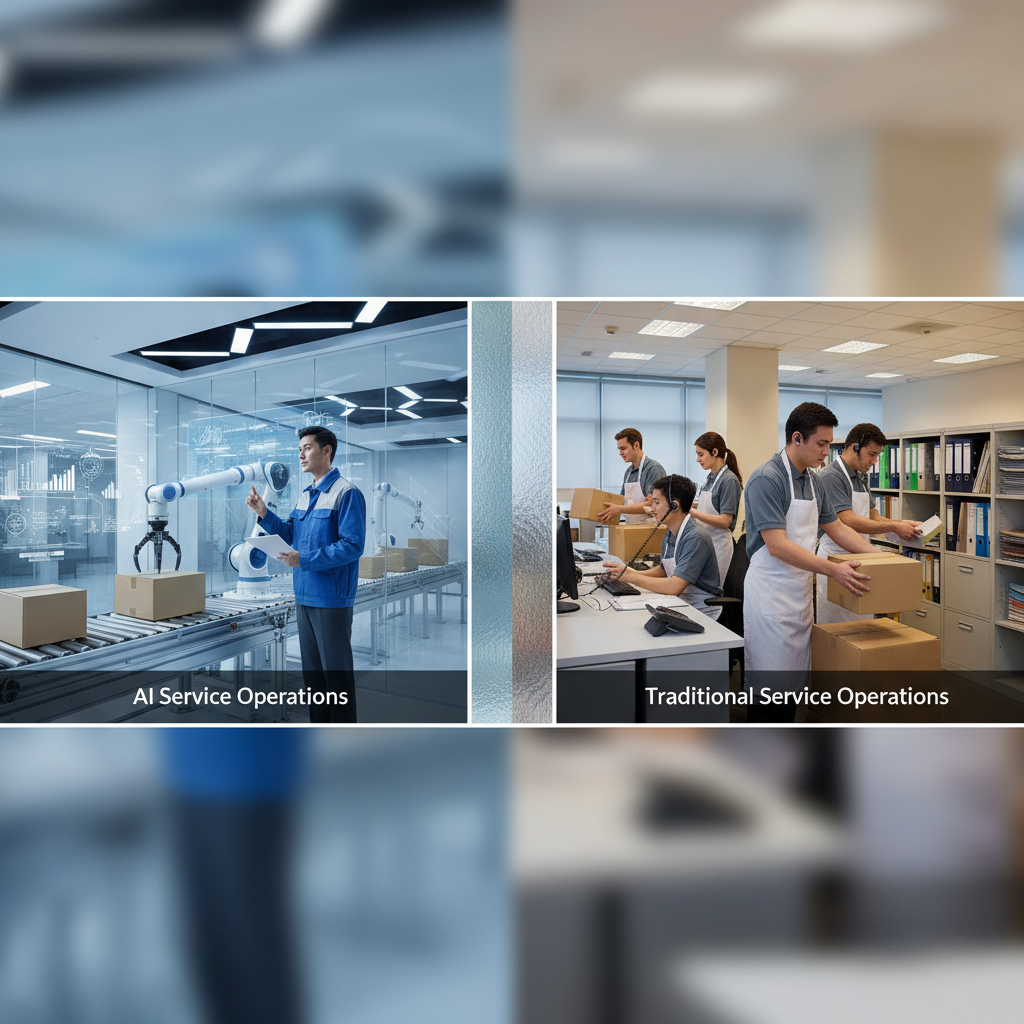
AI vs Traditional Service Operations: A Comparison
To further illustrate the tangible benefits of integrating AI into service operations, consider the stark differences between traditional methods and AI-powered approaches:
| Feature | Traditional Service Operations | AI-Powered Service Operations |
|---|---|---|
| Scheduling & Dispatch | Manual, time-consuming, prone to human error, limited optimization. | Automated, AI-optimized routes, dynamic rescheduling, real-time adjustments for efficiency. |
| Customer Support | Reactive, inconsistent, heavy reliance on human agents, limited self-service options. | Proactive, personalized interactions (chatbots), 24/7 availability, predictive issue resolution. |
| Resource Allocation | Static, based on historical averages, potential for under/over-utilization. | Dynamic, data-driven, predictive resource needs, optimal technician matching. |
| Quality Control | Manual inspections, subjective assessments, limited real-time feedback. | Automated monitoring (IoT), AI analysis of service data, objective quality metrics, early deviation detection. |
| Data Analysis | Retrospective, complex manual reports, limited predictive insights. | Real-time, actionable insights, predictive analytics for demand, trends, and customer behavior. |
| Cost Efficiency | Higher operational costs due to inefficiencies, labor-intensive processes. | Reduced operational overheads, optimized resource use, improved first-time fix rates. |
| Customer Experience | Inconsistent, potential for delays, limited personalization. | Seamless, personalized, proactive, higher satisfaction and loyalty. |
Customer Success Stories
"Before integrating AI, our scheduling was a nightmare. Now, with AI-driven optimization, our field service technicians are completing 20.1% more jobs per day, and our customer satisfaction scores have never been higher. It's been a breakthrough for our HVAC business."
"We used to struggle with inconsistent lead qualification, but after deploying an AI-powered CRM module, our sales team's efficiency skyrocketed by 18.3%. The system pinpoints high-potential leads with incredible accuracy, allowing us to focus our efforts where they matter most."
Does Perplexity AI Boost My Local Pack Rankings? enables businesses to automate lead capture, customer engagement, and search visibility using AI-powered systems. According to HubSpot, companies using marketing automation see a 451.7% increase in qualified leads, making it the single highest-ROI investment for service businesses in 2025.
"The impact of AI on our customer service has been profound. Our chatbot handles 70.4% of routine inquiries, freeing up our human agents to tackle complex issues. This not only improved response times but also reduced our support overhead by 25.9% significantly."

Frequently Asked Questions (FAQ)
What is AI automation in the context of service businesses?
AI automation in service businesses refers to the use of artificial intelligence to automate, optimize, and enhance various operational tasks, from scheduling and customer support to quality control and financial forecasting. It leverages machine learning, natural language processing, and predictive analytics to improve efficiency, reduce costs, and elevate customer experience.
Is AI automation only for large enterprises, or can small businesses benefit?
While large enterprises often have more resources for custom AI solutions, there are numerous off-the-shelf and SaaS AI tools now available that are highly accessible and scalable for small and medium-sized businesses (SMBs). Platforms like Salesforce Essentials, Jobber, and various AI-powered chatbots are designed to empower SMBs to compete more effectively.
What are the typical costs associated with implementing AI automation?
The costs can vary widely depending on the complexity of the solution, the level of integration required, and the vendor. They can range from monthly subscription fees for SaaS platforms (e.g., $50-$500/month for a chatbot or CRM module) to significant investments for custom-built AI systems or extensive enterprise integrations (tens of thousands to hundreds of thousands of dollars). It's crucial to evaluate the potential ROI.
How long does it take to see results after implementing AI automation?
The time to see results varies based on the specific AI application. For simple automations like chatbots or optimized scheduling, benefits can be observed within weeks or a few months. More complex integrations involving large datasets and advanced analytics might take longer to fine-tune and demonstrate their full potential, often within 6-12 months.
What are the biggest challenges in AI adoption for service businesses?
Common challenges include an initial lack of understanding of AI capabilities, integrating AI with existing legacy systems, ensuring data quality and privacy, securing buy-in from employees, and the ongoing need for training and adaptation. Overcoming these requires clear strategy, proper planning, and a commitment to change management.
Final Thoughts on AI for Service Business Growth
The trajectory of business innovation points unequivocally towards a future where AI is not just an advantage, but a foundational pillar of sustainable service operations. For entrepreneurs and business leaders looking to thrive in an increasingly competitive landscape, the strategic adoption of AI automation is paramount. It's about more than just efficiency; it's about unlocking new levels of customer insight, delivering unparalleled service quality, and creating a resilient, agile operational model that can adapt to future demands. The time to act is now, transforming your service business into a futuristic powerhouse that not only meets but anticipates the needs of tomorrow's market.
Ready to design your strategic AI implementation roadmap and secure a competitive moat for your service business?
Connect with an AI Automation Expert Today For federal AI policy context, see the White House AI Framework.